
Keywords
Economic Policy Uncertainty
Outward Foreign Direct Investment
Financing Constraints
How to Cite
Abstract
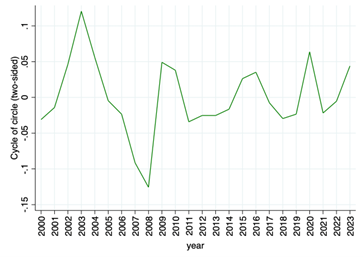
Against the backdrop of a declining financial cycle and heightened economic policy uncertainty, Chinese enterprises face both internal and external challenges in their outward foreign direct investment (OFDI). This study examines A-share listed companies from 2000 to 2023, employing the HP filter method to delineate financial cycles and constructing a linear probability effects model to explore the differential impact of economic policy uncertainty on corporate OFDI from a financial cycle perspective. The findings reveal that economic policy uncertainty significantly suppresses corporate OFDI, with the financial cycle playing a crucial moderating role. During expansion phases, credit expansion and increased risk appetite can mitigate the adverse effects of uncertainty. Conversely, during contraction phases, credit tightening and risk aversion amplify uncertainty, further reinforcing its inhibitory impact. Mechanism analysis indicates that financing constraints serve as the primary transmission channel, as uncertainty exacerbates corporate financing pressures and influences investment decisions. Based on these insights, the paper proposes differentiated policy recommendations: during expansion phases, targeted credit support and cross-border financing mechanisms should guide enterprises in overseas expansion; during contraction phases, targeted relending and measures to stabilize market expectations are essential, alongside optimizing policy formulation and implementation mechanisms to enhance the stability and sustainability of corporate overseas investment.
References
1. Baker, S. R., Bloom, N., & Davis, S. J. (2016). Measuring Economic Policy Uncertainty. Quarterly Journal of Economics, 131(4), 1593–1636. https://doi.org/10.1093/qje/qjw024
2. Che, M., Zhu, Z., & Li, Y. (2023). Geopolitical risk and economic policy uncertainty: Different roles in China’s financial cycle. International Review of Financial Analysis, 90. https://doi.org/10.1016/j.irfa.2023.102867
3. Ding, H., & Ding, N. (2024). Analysis of the effectiveness of macro-prudential policy regulation in China in the context of digital finance. Technological Forecasting and Social Change, 201. https://doi.org/10.1016/j.techfore.2023.123195
4. El Ghoul, S., Guedhami, O., Mansi, S., & Wang, H. (2023). Economic policy uncertainty, institutional environments, and corporate cash holdings. Research in International Business and Finance, 65. https://doi.org/10.1016/j.ribaf.2023.101887
5. Schueler, Y. S., Hiebert, P. P., & Peltonen, T. A. (2020). Financial cycles: Characterisation and real-time measurement. Journal of International Money and Finance, 100. https://doi.org/10.1016/j.jimonfin.2019.102082
6. Xiao, L., Zhao, L., & Zhu, Q. (2024). Host country economic policy uncertainty, trade openness and Chinese enterprise overseas investment. International Review of Economics & Finance, 96. https://doi.org/10.1016/j.iref.2024.103566
7. Xue, X., Wang, L., & Hu, N. (2024). Economic policy uncertainty and corporate social responsibility disclosure similarity: Evidence from China. British Accounting Review, 56(5). https://doi.org/10.1016/j.bar.2023.101305
8. Zhao, Y., & Su, K. (2022). Economic policy uncertainty and corporate financialization: Evidence from China. International Review of Financial Analysis, 82. https://doi.org/10.1016/j.irfa.2022.102182

This work is licensed under a Creative Commons Attribution-NonCommercial 4.0 International License.
Copyright (c) 2025 Haotian Zhu